Discharge Instructions for Open Rotator Cuff Repair
You had a procedure called open rotator cuff repair. The rotator cuff consists of the muscles and tendons that surround your shoulder. The rotator cuff keeps the top of your upper arm bone (humerus) securely in the shoulder joint. Your doctor made an incision near your shoulder blade and repaired the torn muscles or tendons in your shoulder. Here are instructions to follow when caring for your arm at home.
Activity
-
After surgery, rest your arm and relax for the rest of day.
-
If you had general anesthesia, don’t operate power tools or machinery, drink alcohol, or make any major decisions for at least 24 hours following surgery.
-
Wear your sling , brace, or immobilizer, as directed.
-
Don’t drive a car until your doctor says it’s okay. And never drive while taking narcotic pain medication.
-
Flex your wrist and wiggle your fingers often to help blood flow.
-
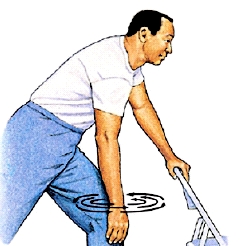
Unless your doctor tells you otherwise, do pendulum exercises with your affected arm, starting 1 day(s) after your surgery:
-
Hold on to the back of a chair, or lean on a tabletop with your healthy hand.
-
Use your torso to move your affected arm in a circle. First do 20 circles in one direction. Then do 20 circles in the other direction.
-
Repeat the pendulum exercise every 2 hour(s) while you are awake. When you feel ready, increase the number of circles to 50 in each direction every 2 hour(s).
Incision Care
-
Don’t soak in a bathtub, hot tub, or pool until your doctor says it’s okay.
-
Your incision was closed using sutures, staples, or strips of tape. If you have sutures or staples, they may need to be removed 2-3 weeks after surgery. Allow the strips of tape to fall off on their own.
Other Home Care
-
Use pain medication as directed by your doctor.
-
Apply an ice pack or bag of frozen peas—or something similar—wrapped in a thin towel on your shoulder to reduce swelling for the first 48 hours. Leave the ice pack on for 20 minutes; then take it off for 20 minutes. Repeat as needed.
-
Take your temperature daily for 7 days after your surgery. Report a fever above 100.4°F to your doctor. Fever may be a sign of infection.
Follow-Up
Make a follow-up appointment as directed by our staff.
When to Seek Medical Attention
Call 911 right away if you have any of the following:
-
Chest pain
-
Shortness of breath
Otherwise, call your doctor immediately if you have any of the following:
-
Increasing shoulder pain or pain not relieved by medication
-
Pain or swelling in the arm on the side of your surgery
-
Numbness, tingling, coolness, or blue-gray color of your arm or fingers on the side of your surgery
-
Fever above 100.4°F or shaking chills
-
Drainage or oozing, redness, or warmth at the incision
-
Nausea or vomiting
© 2000-2025 The StayWell Company, LLC. All rights reserved. This information is not intended as a substitute for professional medical care. Always follow your healthcare professional's instructions.